

三角関数の性質($-\theta$、$\pi\pm\theta$、$\dfrac{\pi}{2}\pm\theta$ などの公式)は、単位円で動径の位置を比べればすべて導けます。忘れたときは加法定理で計算して確かめることもできます。
・$-\theta$:$x$ 軸に関して対称 → $\sin$・$\tan$ は符号が逆、$\cos$ はそのまま
・$\pi-\theta$:$y$ 軸に関して対称、$\pi+\theta$:原点に関して対称
・$\dfrac{\pi}{2}\pm\theta$:$\sin$ と $\cos$ が入れかわる(符号は単位円で確認)
この記事では、それぞれの公式を単位円の図で確認し、加法定理を使った確かめ方と練習問題を解説します。
$\theta+2n\pi$ の公式
$n$ を整数とすると
$\sin(\theta+2n\pi)=\sin\theta$
$\cos(\theta+2n\pi)=\cos\theta$
$\tan(\theta+2n\pi)=\tan\theta$
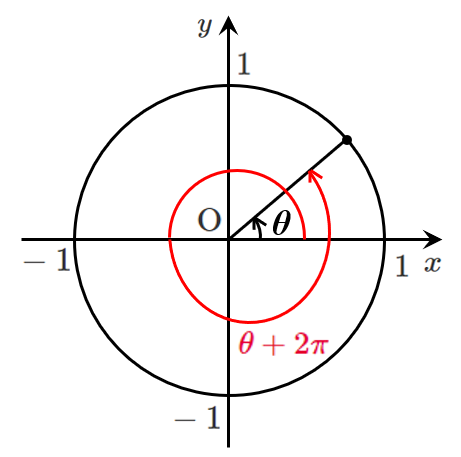
上図のように,動径は $2\pi$ で一周するので,
$\theta+2\pi$ の動径は $\theta$ の動径と同じ位置になる。
同様に,$\theta+2\pi\times2$,$\theta+2\pi\times3$,… の動径
$\theta+2\pi\times(-1)$,$\theta+2\pi\times(-2)$,… の動径
も $\theta$ の動径と同じ位置になる。
よって,$\theta+2\pi\times(整数)$ の動径は,$\theta$ の動径と同じ位置になるので,
整数 $n$ とすると,$\theta+2n\pi$ の動径は $\theta$ の動径と同じ位置になる。
$-\theta$ の公式
$\sin(-\theta)=-\sin\theta$
$\cos(-\theta)=\cos\theta$
$\tan(-\theta)=-\tan\theta$
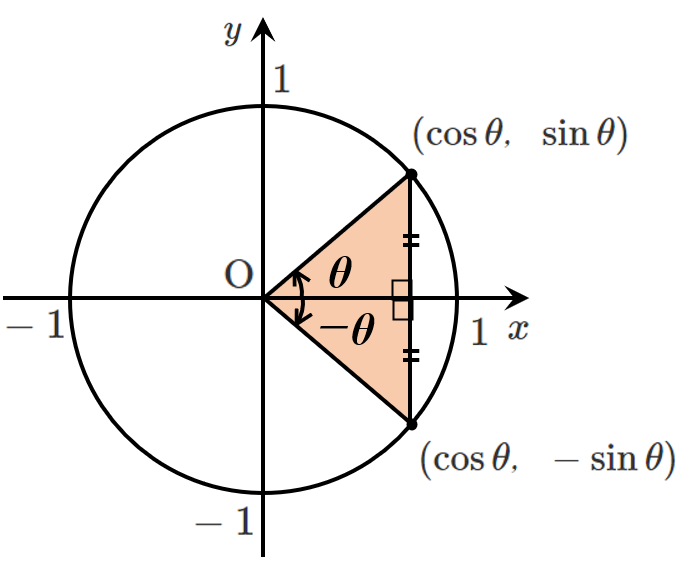
$y$ 座標は符号が異なるので $\sin(-\theta)=-\sin\theta$
$x$ 座標は等しいので $\cos(-\theta)=\cos\theta$
$\displaystyle{\tan(-\theta)=\frac{\sin(-\theta)}{\cos(-\theta)}=\frac{-\sin\theta}{\cos\theta}=-\tan\theta}$
$\pi-\theta$ の公式
$\sin(\pi-\theta)=\sin\theta$
$\cos(\pi-\theta)=-\cos\theta$
$\tan(\pi-\theta)=-\tan\theta$
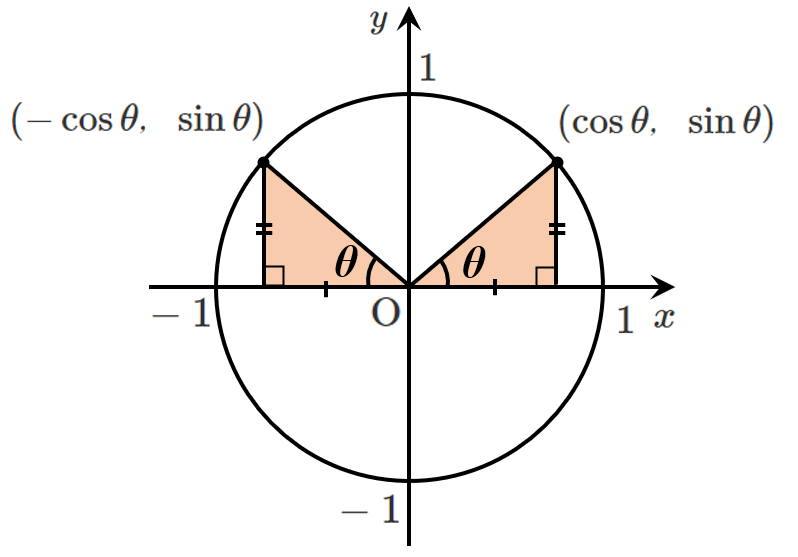
$y$ 座標は等しいので $\sin(\pi-\theta)=-\sin\theta$
$x$ 座標は符号が異なるので
$\cos(\pi-\theta)=\cos\theta$$\displaystyle{\begin{aligned}\tan(\pi-\theta) &= \frac{\sin(\pi-\theta)}{\cos(\pi-\theta)} \\ &= \frac{\sin\theta}{-\cos\theta} \\ &= -\tan\theta\end{aligned}}$
$\pi+\theta$ の公式
$\sin(\pi+\theta)=-\sin\theta$
$\cos(\pi+\theta)=-\cos\theta$
$\tan(\pi+\theta)=\tan\theta$
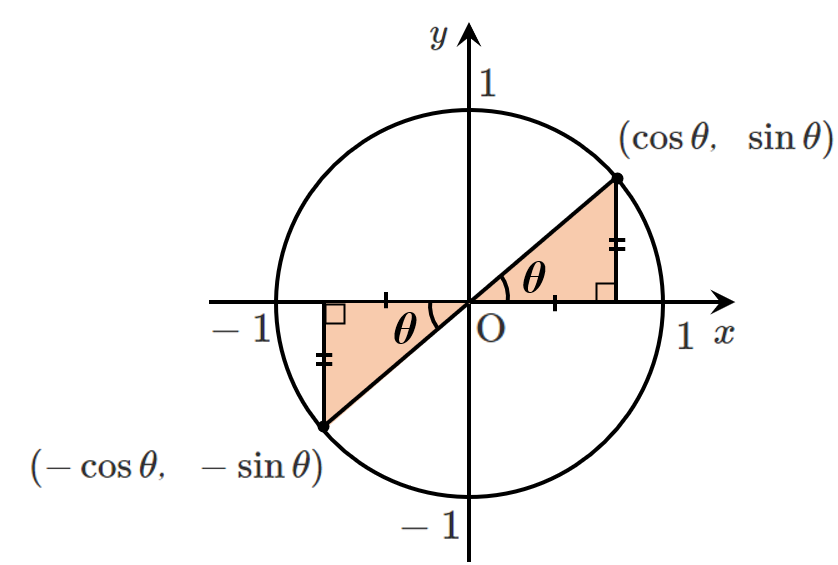
$y$ 座標は符号が異なるので
$\sin(\pi+\theta)=-\sin\theta$
$x$ 座標は符号が異なるので
$\cos(\pi+\theta)=-\cos\theta$
$\displaystyle{\tan(\pi+\theta)=\frac{\sin(\pi+\theta)}{\cos(\pi+\theta)}}$
$\displaystyle{=\frac{-\sin\theta}{-\cos\theta}=\tan\theta}$
$\frac{\pi}{2}-\theta$ の公式
$\displaystyle{\sin\left(\frac{\pi}{2}-\theta\right)=\cos\theta}$
$\displaystyle{\cos\left(\frac{\pi}{2}-\theta\right)=\sin\theta}$
$\displaystyle{\tan\left(\frac{\pi}{2}-\theta\right)=\frac{1}{\tan\theta}}$
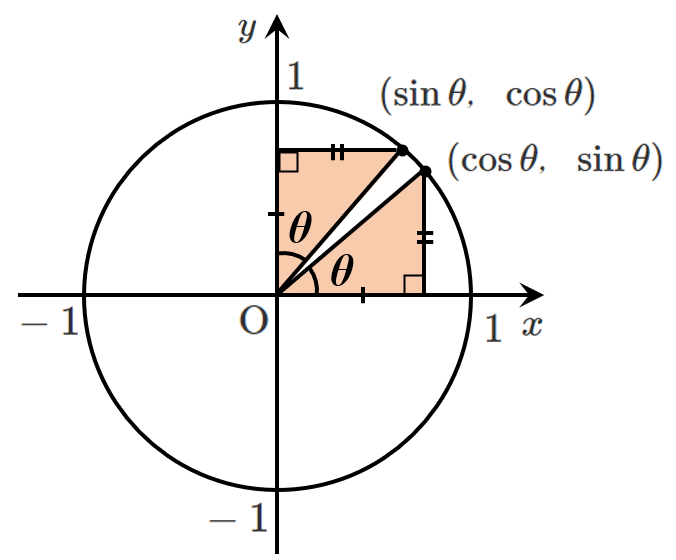
一方の $x$ 座標と他方の $y$ 座標が等しいので
$\displaystyle{\sin\left(\frac{\pi}{2}-\theta\right)=\cos\theta}$
$\displaystyle{\cos\left(\frac{\pi}{2}-\theta\right)=\sin\theta}$
$\displaystyle{\begin{aligned}\tan\left(\frac{\pi}{2}-\theta\right) &= \frac{\sin\left(\frac{\pi}{2}-\theta\right)}{\cos\left(\frac{\pi}{2}-\theta\right)} \\ &= \frac{\cos\theta}{\sin\theta} \\ &= \frac{1}{\tan\theta}\end{aligned}}$
$\frac{\pi}{2}+\theta$ の公式
$\displaystyle{\sin\left(\frac{\pi}{2}+\theta\right)=\cos\theta}$
$\displaystyle{\cos\left(\frac{\pi}{2}+\theta\right)=-\sin\theta}$
$\displaystyle{\tan\left(\frac{\pi}{2}+\theta\right)=-\frac{1}{\tan\theta}}$
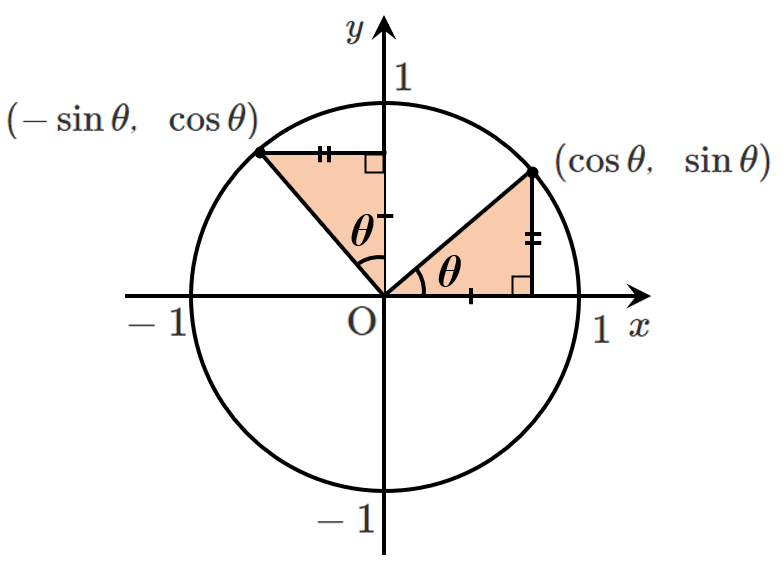
角 $\displaystyle{\frac{\pi}{2}+\theta}$ の $y$ 座標と角 $\theta$ の $x$ 座標が等しいので $\displaystyle{\sin\left(\frac{\pi}{2}+\theta\right)=\cos\theta}$
角 $\displaystyle{\frac{\pi}{2}+\theta}$ の $x$ 座標と角 $\theta$ の $y$ 座標の符号が異なるので $\displaystyle{\cos\left(\frac{\pi}{2}+\theta\right)=-\sin\theta}$
$\displaystyle{\begin{aligned}\tan\left(\frac{\pi}{2}+\theta\right) &= \frac{\sin\left(\frac{\pi}{2}+\theta\right)}{\cos\left(\frac{\pi}{2}+\theta\right)} \\ &= \frac{\cos\theta}{-\sin\theta} \\ &= -\frac{1}{\tan\theta}\end{aligned}}$
三角関数の性質の公式を導く3ステップ
- STEP1単位円に θ と変換後の角の動径をかく
例:$\pi+\theta$ なら、$\theta$ の動径を原点のまわりに $\pi$ 回転させた位置。
- STEP22つの点の座標の関係を読む
$\pi+\theta$ の点は $\theta$ の点と原点に関して対称なので、$(x,\ y)\to(-x,\ -y)$。
- STEP3sin=y、cos=x、tan=y/x にあてはめる
$\sin(\pi+\theta)=-\sin\theta$、$\cos(\pi+\theta)=-\cos\theta$、$\tan(\pi+\theta)=\tan\theta$。
困ったら加法定理で計算
図を描いて思い出すのが重要ですが,
テストとかで困ったら『加法定理』で求まります!
加法定理はこれ↓
$\sin(\alpha+\beta)=\sin\alpha\cos\beta+\cos\alpha\sin\beta$
$\sin(\alpha-\beta)=\sin\alpha\cos\beta-\cos\alpha\sin\beta$
$\cos(\alpha+\beta)=\cos\alpha\cos\beta-\sin\alpha\sin\beta$
$\cos(\alpha-\beta)=\cos\alpha\cos\beta+\sin\alpha\sin\beta$
$\displaystyle{\tan(\alpha+\beta)=\frac{\tan\alpha+\tan\beta}{1-\tan\alpha\tan\beta}}$
$\displaystyle{\tan(\alpha-\beta)=\frac{\tan\alpha-\tan\beta}{1+\tan\alpha\tan\beta}}$
加法定理の使い方の例
$\sin(\pi+\theta)=\sin\pi\cos\theta+\cos\pi\sin\theta$
$=0\cdot\cos\theta+(-1)\cdot\sin\theta$
$=-\sin\theta$
$\cos(\pi+\theta)=\cos\pi\cos\theta-\sin\pi\sin\theta$
$=(-1)\cdot\cos\theta-0\cdot\sin\theta$
$=-\cos\theta$
$\displaystyle{\tan(\pi+\theta)=\frac{\tan\pi+\tan\theta}{1-\tan\pi\tan\theta}}$
$\displaystyle{=\frac{0+\tan\theta}{1-0\cdot\tan\theta}}$
$=\tan\theta$

これで忘れても安心だね!
練習問題
(1) $\sin\dfrac{7}{6}\pi$ (2) $\cos\left(-\dfrac{\pi}{3}\right)$ (3) $\tan\dfrac{5}{6}\pi$ (4) $\sin\dfrac{2}{3}\pi$
(1) $\displaystyle{\sin\frac{7}{6}\pi=\sin\left(\pi+\frac{\pi}{6}\right)}$
$\displaystyle{=-\sin\frac{\pi}{6}=-\frac{1}{2}}$
(2) $\displaystyle{\cos\left(-\frac{\pi}{3}\right)=\cos\frac{\pi}{3}=\frac{1}{2}}$
(3) $\displaystyle{\tan\frac{5}{6}\pi=\tan\left(\pi-\frac{\pi}{6}\right)}$
$\displaystyle{=-\tan\frac{\pi}{6}=-\frac{1}{\sqrt{3}}}$
(4) $\displaystyle{\sin\frac{2}{3}\pi=\sin\left(\frac{\pi}{2}+\frac{\pi}{6}\right)}$
$\displaystyle{=\cos\frac{\pi}{6}=\frac{\sqrt{3}}{2}}$
三角関数の性質でよくある質問

コメント